Reviews

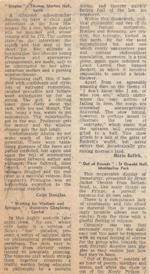
| The No One Theatre Company, in common with all other companies, has no interest whatsoever in the judgements of the critics, as we are motivated solely by our own belief in the value of our art. It was with great reluctance therefore that we forced ourselves to read the review from The Scotsman, and it is with great humility that we present it here. These critics are clearly a picky bunch: the reviews of the other shows on this page include "Pace faltered, lines limped ... and the end came as a merciful release" and "This impeccable display of immaturity ... is, like many things on the Fringe, a pursuit of zaniness for its own sake". In comparison, the review for "Waiting for Vladimir and Estragon" stands out as a jewel of faint mediocrity in a crown of acidic invective: |
|
“In this highly esoteric late-night show, “No one,” whose very name is a version of Zeno’s “liar” paradox, presents a series of satirical skits on philosophical problems and paradoxes. The skits vary in quality from cleverly entertaining to low-grade punning. The tenuous plot which strings them together concerns a traffic warden being educated in philosophy by a socratic tramp, and thereby quickly falling foul of the law, his employer.
“Within this framework. political philosophy, and two of its most famous instigators, Hobbes and Rousseau, are crudely, but tellingly, kicked in the pants. By far the most accomplished bit, and one which neatly summarises past and current philosophical speculation, moreover, is a trial scene, much more indebted to Lewis Carroll than Samuel Beckett, in which it becomes impossible to convict a brick-thrower.
“Apart from an agreeably amusing duet on the theme of “I don’t know who I am, or who you are,” which undermines the very notion of falling in love, the songs are somewhat unenergetically delivered. The slow timing, however, is perhaps meant to illustrate the law of “entrophy,” (sic) which states that the universe will eventually grind to a halt. This show grinds to a halt at the gates of Beckett’s world, but never enters that paradoxically promising no-man’s land.”