
Scripts
Plot: Victor Allsop, a traffic warden, has a chance encounter with Ernest Nunn, a vagrant with an impressively extensive knowledge of philosophy. They strike up an unlikely friendship which leads to an exploration of some of the fundamental ideas underpinning ethics, politics, epistemology, metaphysics, religion and the Highway Code. The ingeniously constructed plot, warmly praised by The Scotsman as “tenuous”, provides the framework for a series of dream-like sequences that bear a remarkable similarity to the kinds of sketches and songs performed at late-night revues. A modest selection is shown here.
| The Court Sketch How do we know what we know? How can we know whether evidence is true? What do we mean by the truth? Can something be both true and false at the same time? Can the opposite of what is true also be true? Who could answer such questions? Would anyone want to know the answers? (Warning: this sketch may contain fried egg.) | 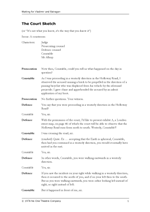 |
| The Identity Song Who am I? Who are you? How do I know who I am or who you are? What is it that defines who I am? What does identity mean? Is it possible that I might be someone else entirely different? What might rhyme with 'Queen Victoria'? | 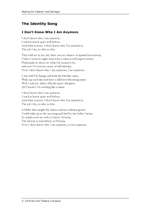 |
| The School Sketch How can we know whether our actions are good or bad? Should we judge our actions according to the effect that they have or by our motives for doing them? Perhaps neither, but by an appeal to authority? Why are there so many questions, but so few answers? Was that a rhetorical question? | 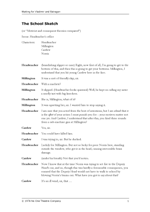 |
| The Nationwide Sketch Is there an independently existing material world or is everything just perception? Does a tree cease to exist if no one is looking at it? Does the same apply to a tomato? Are you old enough to remember that 'Nationwide' was an early-evening current affairs television programme? | 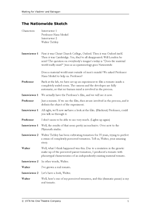 |
| The Time Song Is my mind a different kind of thing to my body? If it is, then how does it interact with the physical world? How can we perceive a sequence of cause and effect if our minds cannot interact with the world? Is our perception of time an illusion? For those watching this performance, why did time appear to move so much more slowly inside the theatre than outside it? |  |
Towards the end of the performance, the Time Song becomes disjointed and arrhythmic as the fabric of time itself dissolves. The dialogue begins to overlap and become repetitive …. the performers find themselves improvising ….. To borrow a phrase from Leonardo, the script is not so much finished as abandoned. The audience emerge from the theatre, questions buzzing in their minds, onto an empty Edinburgh street under a clear midnight sky. They look up at the stars, reflecting on how small they are in the vastness of the universe, wondering how they are going to get home, and thinking that maybe they should have gone to the Footlights revue after all.